The picture most people carry is a bone slipping out of place and pinching a nerve, like a foot on a garden hose.
Memorable. Also about forty years out of date.
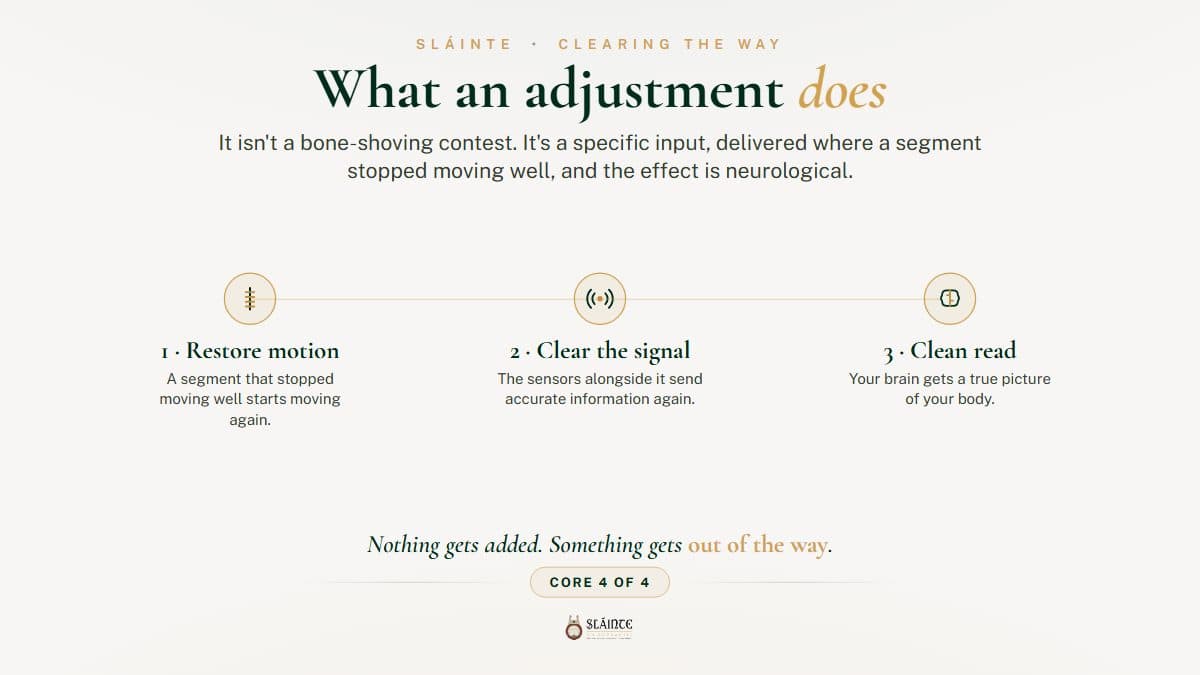
Your brain doesn't automatically know what's going on in your body. It builds a picture, moment to moment, off a stream of signals coming up your spine. A huge share of that stream comes from tiny sensors packed into the small muscles alongside each segment.
Those sensors are your brain's eyes on your body. Where everything is. How it's moving. What's loaded.
When a segment stops moving the way it should, those sensors send a fuzzy version of the story. And your brain builds its picture off the fuzzy version.
Think of a dimmer switch turned partway down. The signal is still coming through. It just isn't clear.
In chiropractic we call that a subluxation. It's a breakdown in the way the brain perceives and controls movement of the spine. Nothing in there is broken. It's a function problem.
The rule we use for what follows: altered input alters output. Fuzzy information going up, fuzzy response coming back down. And a brain working off bad intel tends to stay a little on guard, because on some level it knows it's guessing.
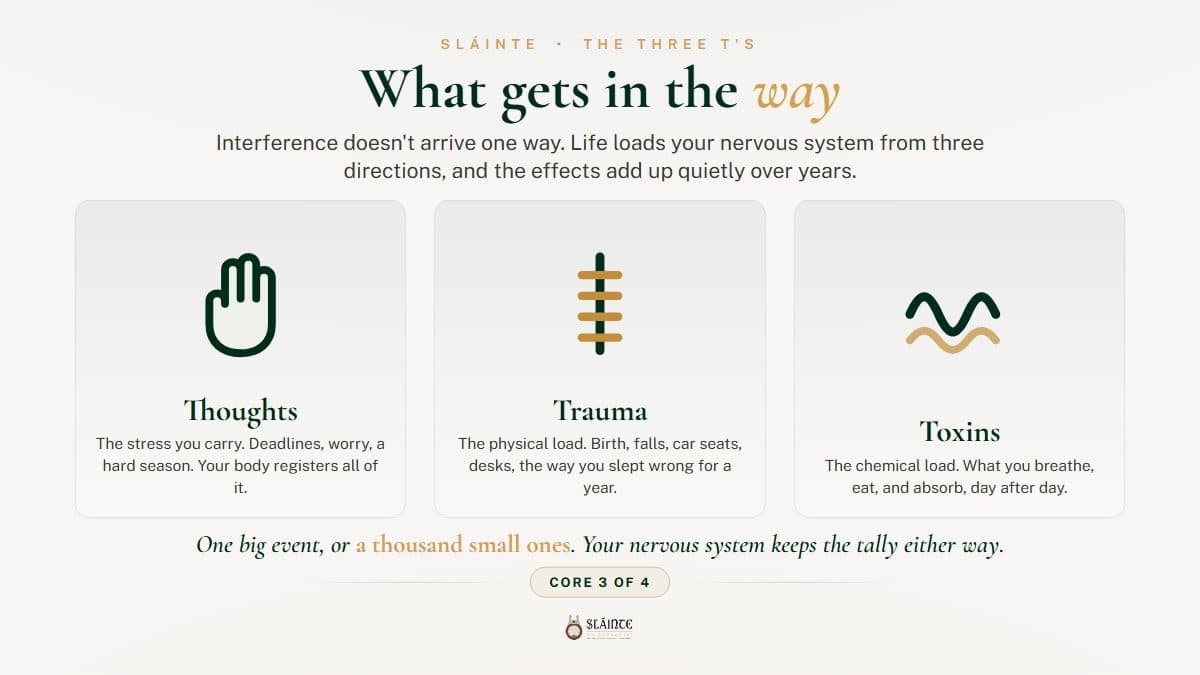
You can't feel any of this happening. That's what makes it hard to catch. You can't feel whether your spine is moving right any more than you can feel your blood pressure. It builds up quietly while your body adapts around it, and if pain shows up at all, it shows up late.
So that's what gets in the way. A quiet drift in the road your health travels on.
Which leaves the last question. What clears it?
Keep reading: The Foundation
Individual results vary. Chiropractic care does not diagnose, treat, or cure any disease or condition. This information is educational and not a substitute for medical care. Sláinte provides wellness chiropractic care and works alongside your medical team.
Ready to put this into practice for your family?
Your first visit includes our INSiGHT nervous system scans. X-rays, if clinically necessary, are always discussed with you first.