There's a door in most houses that swings beautifully one direction and fights you the other.
Nothing about it is broken. The frame settled, or the hinge sits a little proud, and the door has stopped swinging evenly. You wouldn't panic about it. You'd look at it.
That's roughly the right emotional temperature for what follows.
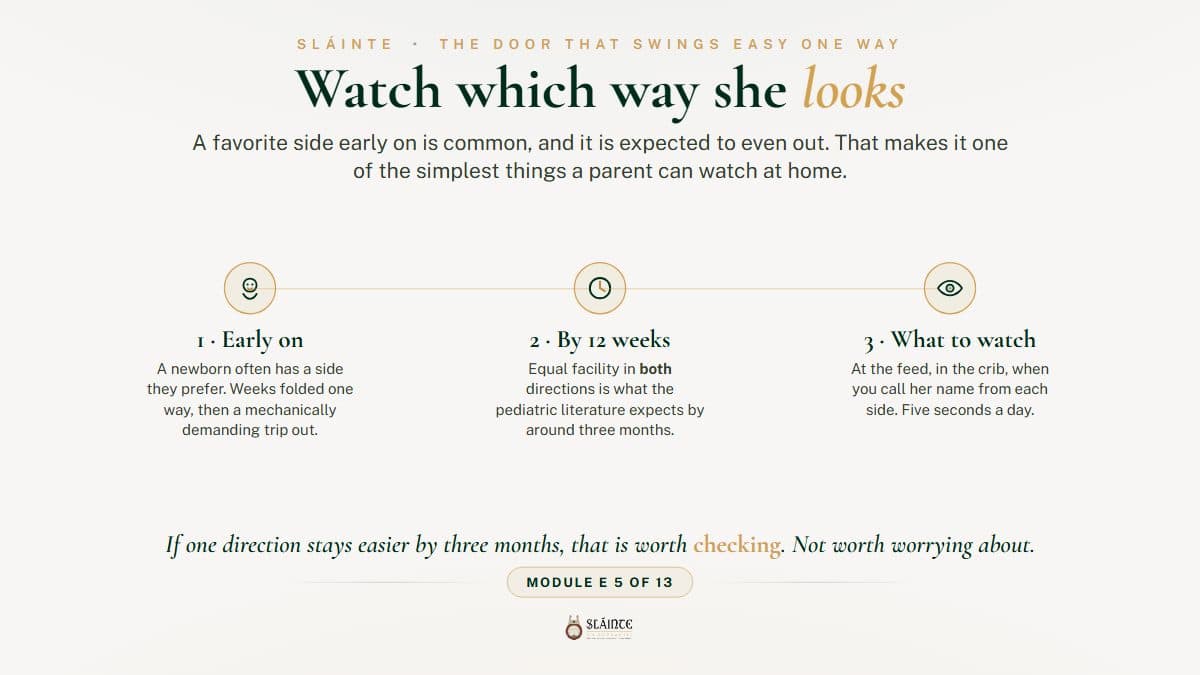
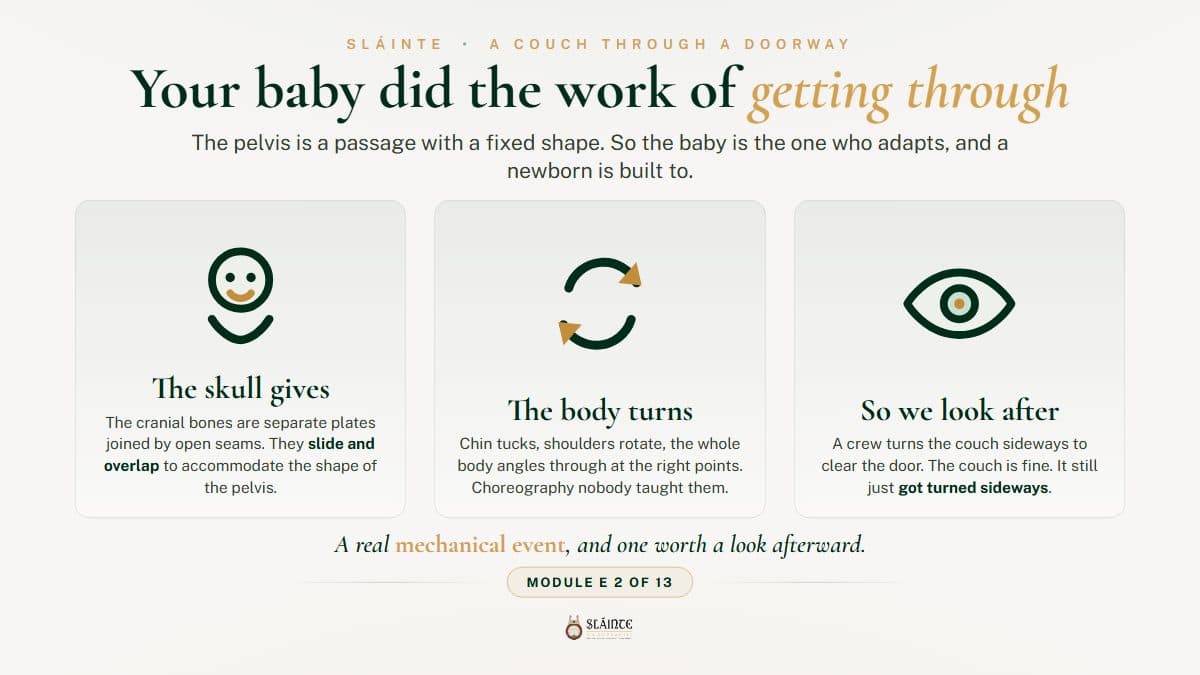
Newborns commonly have a favorite side. They spent weeks folded a particular way, they came through a mechanically demanding trip, and a preference early on is ordinary. It's also expected to even out. By around twelve weeks, a baby should turn her head about as easily one way as the other.
That's not a deadline and it isn't a countdown. It's a checkpoint, and the useful thing about a checkpoint is that you can stand at it yourself, in your own living room, without an appointment.
So here's how to watch it.
At the feed. Most babies get held on both sides across a day. Notice whether one side is a wrestle and the other is easy.
In the crib. When she settles, which way does the head end up? Same direction every night, or does it vary?
When you call her. Stand on one side, say her name, watch her come toward you. Then the other side. You're not testing her. You're looking at how far and how easily the head travels each way.
That's the whole home version. It costs nothing.
The part I care about most isn't the neck. You're the one who notices this first. Long before us, and long before a well visit, where somebody sees your daughter for a few minutes on a table in a room she doesn't like. You're with her all day and you've been reading her since the first week.
So if something's been sitting in the back of your mind about which way your baby looks, you're not overreacting by mentioning it. You're reporting.
What we do with it is check how the neck moves. Each segment, both directions, by hand, and we write down what we find so it can be compared next month. That's a measurement, not a verdict. And if what we see sits outside what we look at, we'll tell you plainly and tell you who to talk to.
If one direction stays easier by around three months, that's worth checking. Not worth worrying about. Worth checking.
Keep reading: Babies and Development
Individual results vary. Chiropractic care does not diagnose, treat, or cure any disease or condition. This information is educational and not a substitute for medical care. Sláinte provides wellness chiropractic care and works alongside your medical team.
Ready to put this into practice for your family?
Your first visit includes our INSiGHT nervous system scans. X-rays, if clinically necessary, are always discussed with you first.