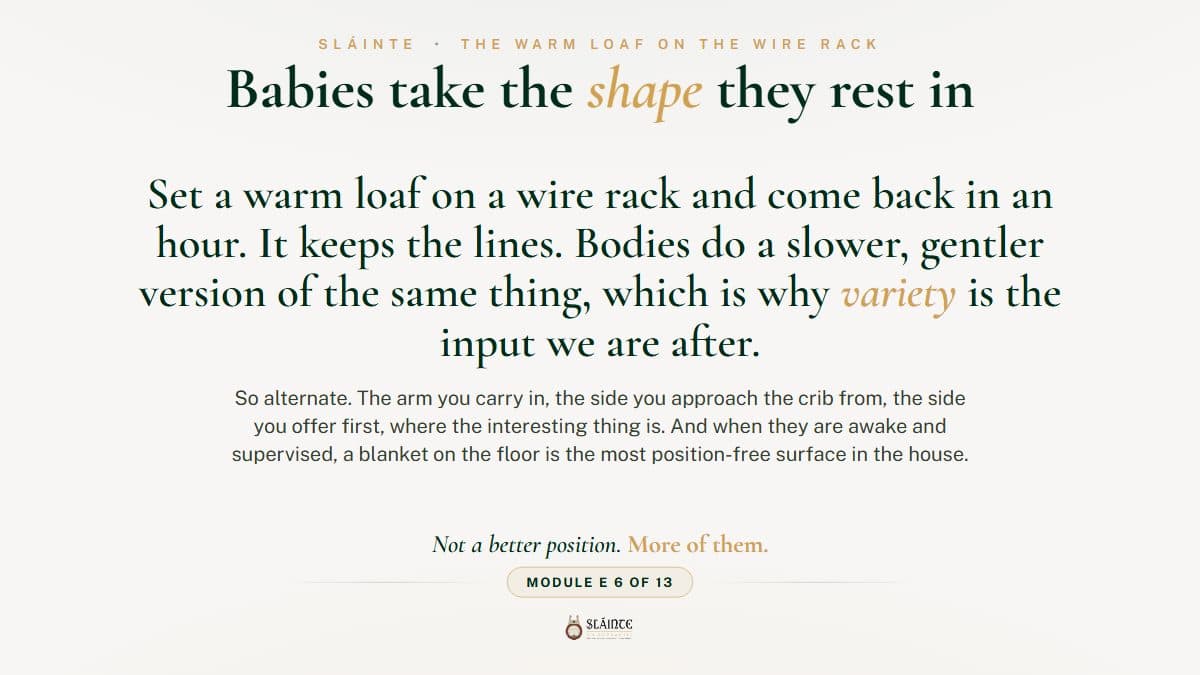
Pull a loaf out of the oven and set it on a wire rack. Come back an hour later and the bottom has the rack printed into it, in neat parallel lines.
Nobody did anything to the bread. Nobody pressed it. It was warm, it was soft, and it sat still, and it took the shape of what it was resting on.
Bodies do a slower, gentler version of the same thing.
A baby is soft and growing quickly. Muscle, ligament and joint capsule are all still organizing themselves, and they organize around what they're actually being asked to do. A position held for a few minutes asks almost nothing. The same position held for hours a day, across weeks, is an input, and I think a growing body is very good at answering an input.
So what I care about isn't finding the one correct way to put a baby down. It's not letting any one arrangement run for long stretches.
Which brings up the thing every parent's mind jumps to, so let me say it directly. The car seat is right, every time, no exceptions. It's doing a safety job nothing else can do, and it isn't up for discussion in this office or anywhere else. The only thing worth knowing is that hours are hours. So when you arrive, the floor and your arms are simply a change of input. Same for the swing, the bouncer and the carrier, all of which are genuinely useful and all of which exist so you can put the baby down and eat something.
This also isn't a verdict on how you've been holding your baby. Babies have a favorite arm and so do parents. There's nothing to feel bad about here and no lost ground to make up.
So here's the habit. Alternate.
The arm you carry in. Most of us have a side and have never thought about it. Which side of the crib you approach from, because she turns toward you, and toward the door, and toward the window. Which side you offer first at a feed. Where the interesting thing is: toys, your face, the light, the dog.
None of that takes extra time. It's the same day, pointed a different direction every so often.
Variety is the whole input.
Keep reading: Babies and Development
Individual results vary. Chiropractic care does not diagnose, treat, or cure any disease or condition. This information is educational and not a substitute for medical care. Sláinte provides wellness chiropractic care and works alongside your medical team.
Ready to put this into practice for your family?
Your first visit includes our INSiGHT nervous system scans. X-rays, if clinically necessary, are always discussed with you first.