Nobody has ever learned a jump shot in a lesson.
You learn it on an empty floor over a summer, one repetition at a time, and the repetitions are boring and nobody is watching. Ten thousand of them and the shot is yours for life.
The most ordinary-looking thing your baby does on the living room rug is exactly that.
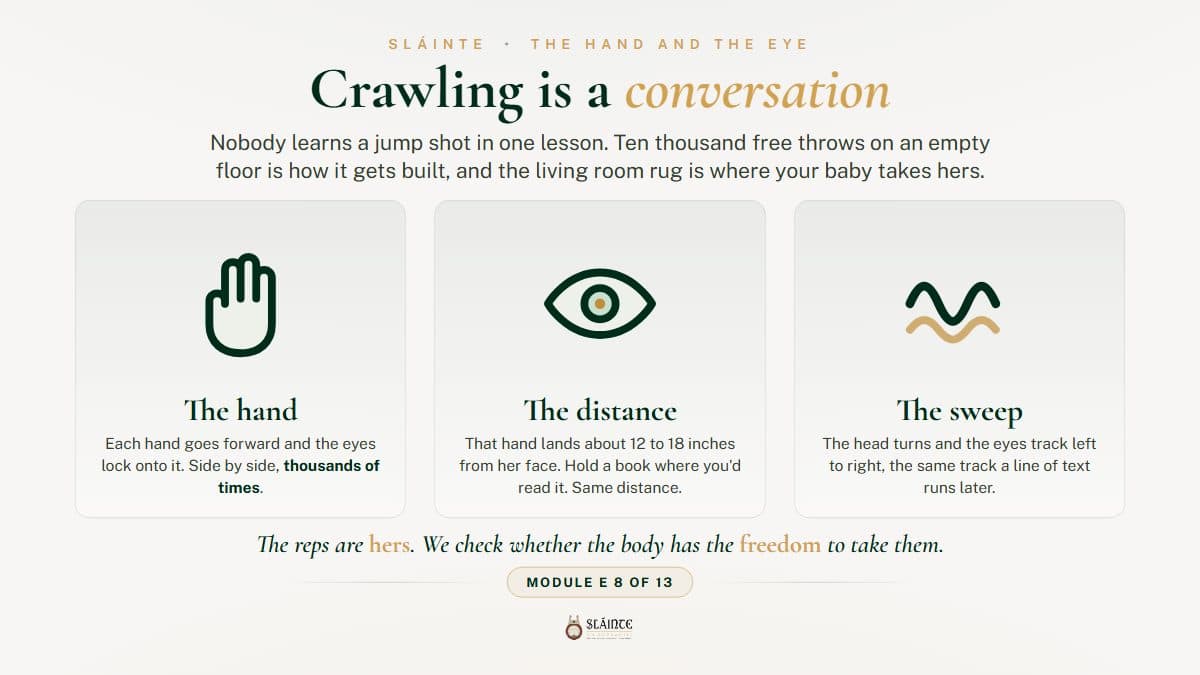
Watch a baby crawl and you'll notice something the first time you look for it, and then you won't be able to stop seeing it. As each hand goes forward, the eyes go with it. The hand lands and the eyes are already there. Then the other hand, and the eyes again. Thousands of times, in a stretch of the day nobody thinks of as practice.
Two things about that deserve a parent's attention.
The first is the distance. A crawling baby's hand comes down somewhere around twelve to eighteen inches from her face. Hold a book where you'd actually read it. Same distance. Later on, a page, a worksheet and a tablet at a kitchen table all sit in roughly that same place.
The second is the sweep. Crawling turns the head and carries the eyes left to right, over and over, which is the same track a line of text runs later.
That's as far as I'll take it, because this is a place my whole field overstates. This is what developmental clinicians observe, and it's thought to contribute. It is not a promise about reading, and anybody who tells you crawling guarantees a reader has gone well past what anyone knows.
What I'll say honestly is that crawling looks to me like a stretch of enormous, cheap, self-directed practice at a skill your child will use for the rest of her life, and the floor is where that practice happens.
Which makes the practical part a very low bar. Floor time. Not equipment, not a program, not a class you drive to. A flat surface, something interesting a little way off, and time.
Where we come in is narrow. We look at whether the body has the freedom to do this work. Whether the neck turns as easily one way as the other, whether the hips and shoulders move well, whether being down on the belly is comfortable enough to stay there a while. If something is making that harder than it needs to be, we clear what we find.
The reps are hers. They always were.
Keep reading: Babies and Development
Individual results vary. Chiropractic care does not diagnose, treat, or cure any disease or condition. This information is educational and not a substitute for medical care. Sláinte provides wellness chiropractic care and works alongside your medical team.
Ready to put this into practice for your family?
Your first visit includes our INSiGHT nervous system scans. X-rays, if clinically necessary, are always discussed with you first.