Somebody will tell you that you're holding the baby too much. Usually kindly, usually someone who loves you, often in a kitchen.
I'd like to give you something better to say back, and it isn't a parenting opinion. It's how the input works.
Touch is a sense. That sounds obvious until you sit with the size of it. Skin is the largest sensory surface a person has, it's among the earliest senses to come online before birth, and it's running continuously from the first day. Pressure, warmth, the small rhythmic sway of being carried across a room. All of that is information travelling into a nervous system whose whole job right now is figuring out what the world is like and what settled feels like in it.
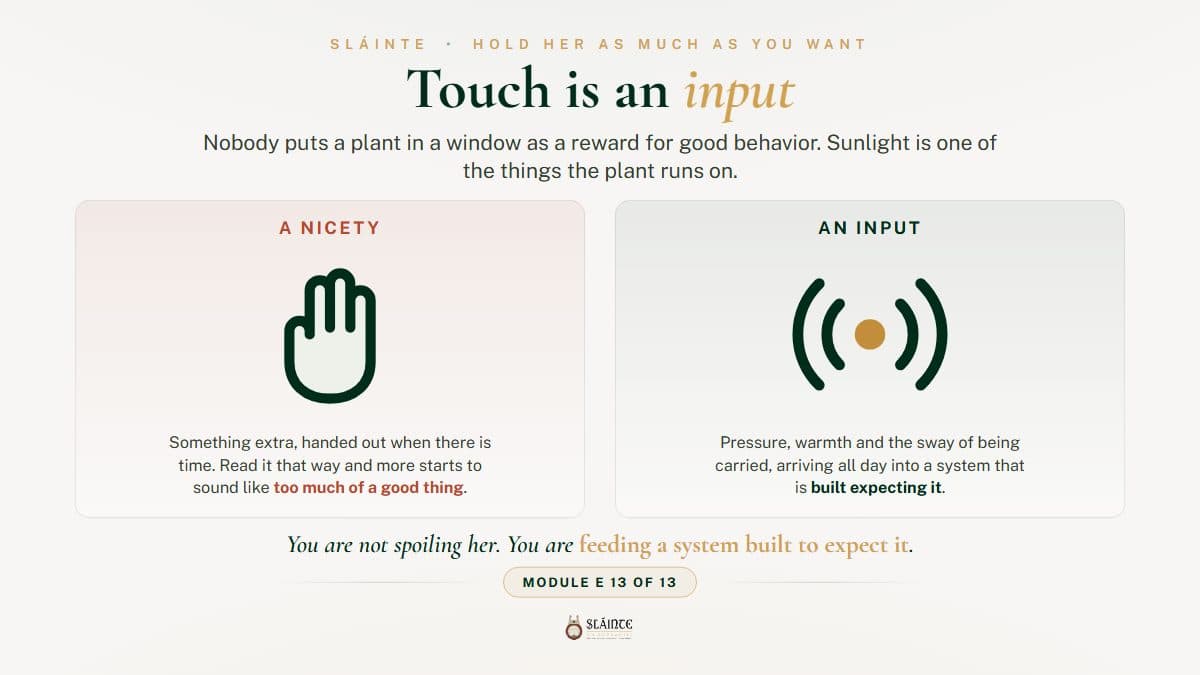
Which is why I don't think of touch as a nice extra layered on top of the important stuff. As best I understand early development, it sits in the same category as food and sleep. Not pleasant. Not enriching. An input, in the way that inputs matter.
Which brings me to the analogy I keep coming back to. Sunlight for a plant.
Nobody puts a plant in a window as a reward for good behavior. Nobody worries the plant is getting spoiled, or wonders whether all that light is going to make it dependent. Sunlight is one of the things the plant runs on, and the plant is built assuming it'll be there.
That's the category touch belongs in for a baby. Input.
So here's the part I want you to take home, as permission rather than one more thing to manage.
There's no quota. No target number of minutes, no scoreboard, nothing you can come up short on by the end of the day. Ordinary life with a baby delivers it constantly without anybody trying. Feeding, carrying her out to the car, a diaper change, wearing her around the kitchen while you make dinner one-handed, a hand on her back at two in the morning.
You've already been doing this all week. It counts.
And nobody spoils a baby by holding her. That worry is old and it's sturdy and it's worth setting down.
One small thing worth mentioning to me, as an observation rather than a concern. Some babies are harder to hold comfortably. She arches, or she settles on one shoulder and fights the other. That's a movement observation and it's useful information.
Hold her as much as you want. You're feeding a system built to expect it.
Keep reading: Babies and Development
Individual results vary. Chiropractic care does not diagnose, treat, or cure any disease or condition. This information is educational and not a substitute for medical care. Sláinte provides wellness chiropractic care and works alongside your medical team.
Ready to put this into practice for your family?
Your first visit includes our INSiGHT nervous system scans. X-rays, if clinically necessary, are always discussed with you first.