If your child has a folder of specialists, one for speech, one for behavior, one for sensory, one for feeding, you've probably felt the strange thing about it. Everyone is working hard, and nobody is describing the same child.
That isn't anyone's fault. It's what happens when help gets organized around a machine model.
When something goes wrong with a machine, you find the broken part and replace it. A lot of the help offered to struggling children quietly runs on that logic: find the broken piece, work on that piece. It's tidy, and it's why the folder gets thick.
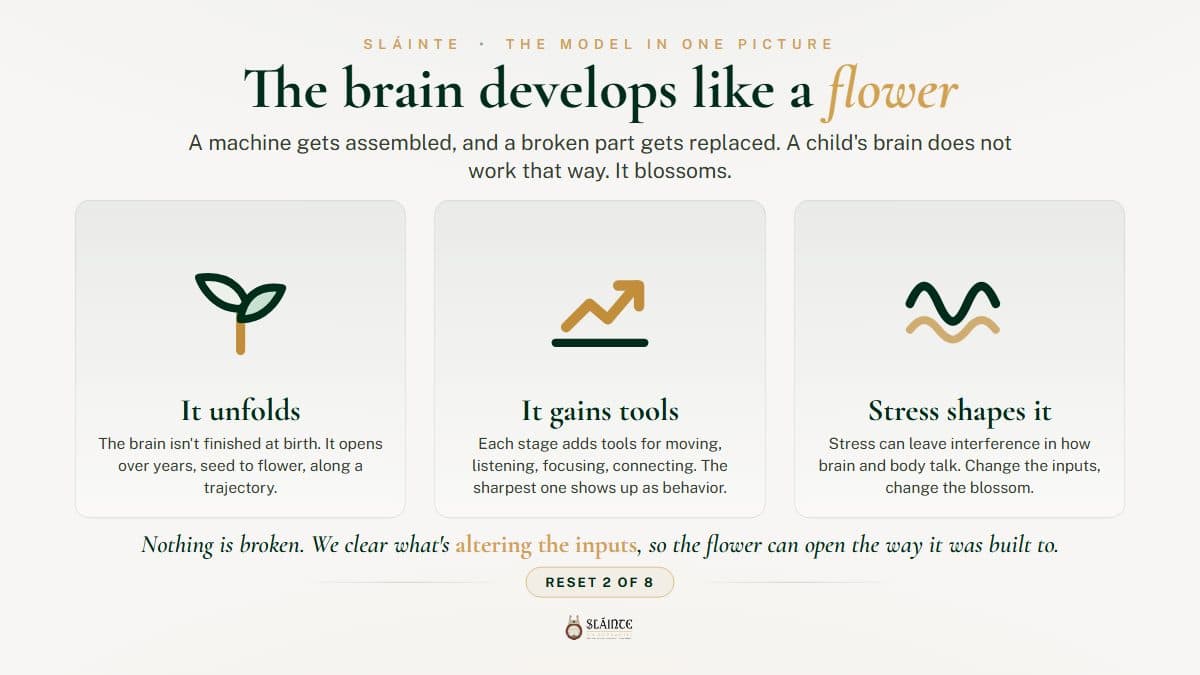
But a child's brain doesn't get assembled like a machine. It develops the way a flower blossoms. Once you see it that way, the whole picture reorganizes.
Here's the model, and it's built on three things almost everyone in child development already agrees on.
First, the brain isn't finished at birth. It develops along a trajectory, opening up over years from a seed into a flower. At each stage it looks a little different, and it's doing a little more.
Second, at each stage a child gains new and more sophisticated tools: tools for moving, listening, focusing, connecting, thinking. The tool a child is sharpest with right now is the one they lean on, and that's what shows up as their behavior. A child leaning on movement and touch to make sense of the world is the child who has to touch everything and can't sit still. That isn't misbehavior. That's their current primary tool, doing its job.
Third, stress can change how that flower blossoms. And here's the nuance I think matters most: usually it isn't the stress itself, it's the changes stress leaves behind in the brain and body. One of those changes is interference in how the brain and body communicate. A seed given the wrong inputs, too little water or too much, blossoms differently. So does a developing brain running on a distorted signal.
That's where we come in, and it's a narrow lane on purpose. We're not trying to replace a broken part, because nothing is broken. We're looking for the interference that's altering the inputs, and clearing it, so accurate information gets through and the flower can blossom the way it's built to.
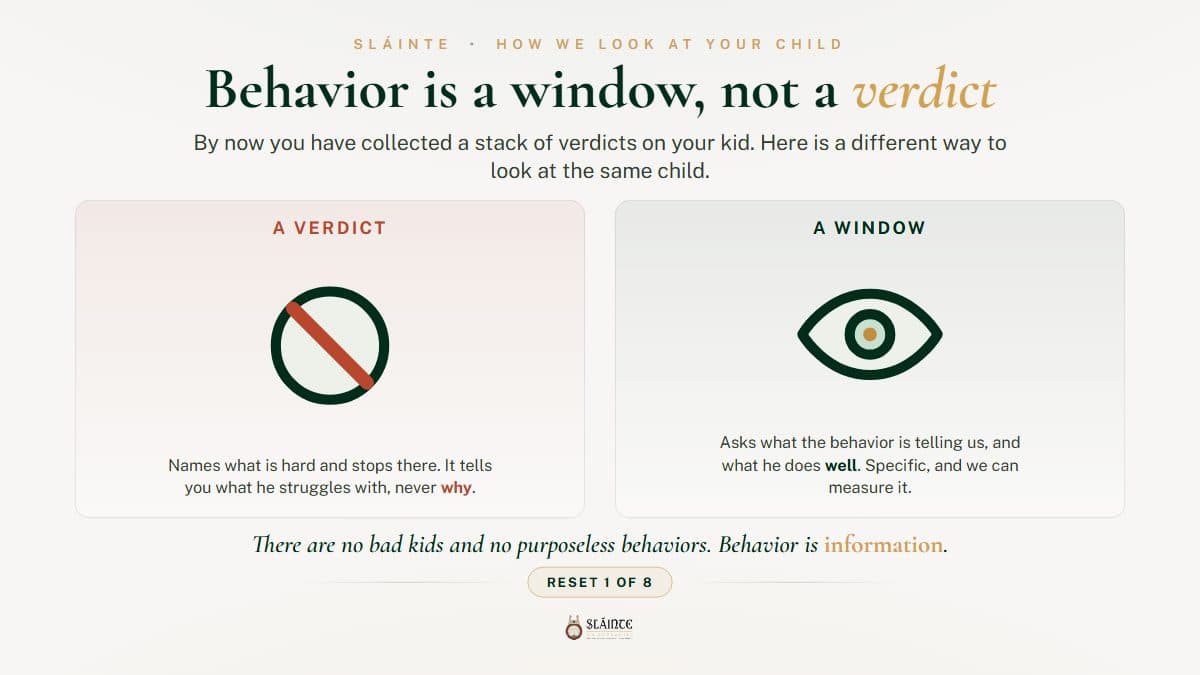
It's also why we don't chase each symptom in its own silo. When you understand the brain as one trajectory unfolding, you stop asking "which part is broken?" and start asking "what's getting in the way of the whole thing developing?"
In my experience that's a better question. Better questions tend to lead somewhere.
Keep reading: The Nervous System Reset
Individual results vary. Chiropractic care does not diagnose, treat, or cure any disease or condition. This information is educational and not a substitute for medical care. Sláinte provides wellness chiropractic care and works alongside your medical team.
Ready to put this into practice for your family?
Your first visit includes our INSiGHT nervous system scans. X-rays, if clinically necessary, are always discussed with you first.